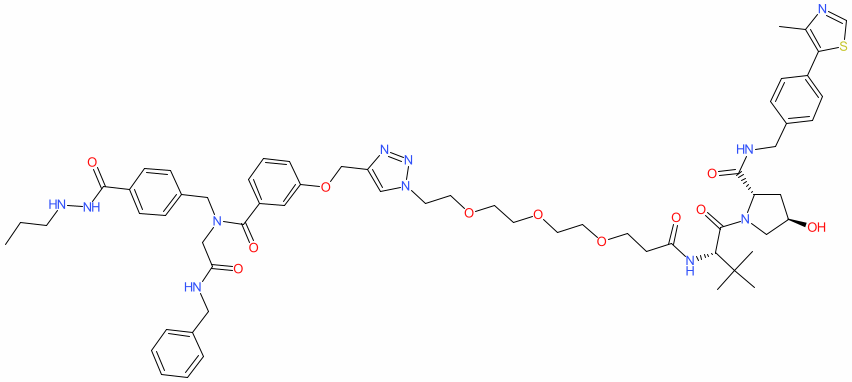
HDAC3 degrader 2b 
GtoPdb Ligand ID: 14744
|
Compound class:
Synthetic organic
Comment: This compound is reported as a selective degrader of the histone deacetylase 3 (HDAC3) protein [2]. It is a von Hippel-Lindau (VHL)-recruiting degrader that is built upon a peptoid scaffold, and uses VHL ligand VH032, HDAC inhibitor FL-007 [1] to engage the E3 ligase and target protein, respectively.

Ligand Activity Visualisation ChartsThese are box plot that provide a unique visualisation, summarising all the activity data for a ligand taken from ChEMBL and GtoPdb across multiple targets and species. Click on a plot to see the median, interquartile range, low and high data points. A value of zero indicates that no data are available. A separate chart is created for each target, and where possible the algorithm tries to merge ChEMBL and GtoPdb targets by matching them on name and UniProt accession, for each available species. However, please note that inconsistency in naming of targets may lead to data for the same target being reported across multiple charts. ✖ |
|
|||||||||||||||||||||||||||||||||||
| References |
|
1. Eichhorn JM, Menning J, Schäker-Hübner L, Hansen FK, König P, Bendas G. (2026)
Novel Class I HDAC Inhibitors Sensitize Ovarian Cancer Cells for Cisplatin and Niraparib via an HDAC3-SLFN11 Axis. ACS Chem Biol, 21 (9): 2169-2178. [PMID:42607195] |
|
2. Lepper S, Biermann L, Kraft FB, Feller F, Tan K, Setia N, Martens EC, Hamacher A, Schäker-Hübner L, Kassack MU et al.. (2026)
Discovery of Potent and Non-cytotoxic HDAC3-Selective Degraders Featuring a Propyl Hydrazide Zinc-Binding Group. J Med Chem, Epub ahead of print. DOI: 10.1021/acs.jmedchem.6c01065 |




Creative Commons Attribution-ShareAlike 4.0 International License